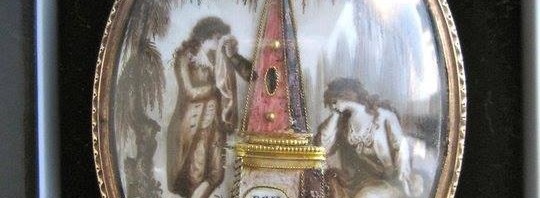
One of the most difficult concepts to gasp when identifying and appreciating mourning jewels is trying to separate the emotional context from the facts of the piece. In most cases, a simple evaluation can extrapolate what the jewel is, when it was created and who it was created for. These jewels are monuments, fashionable tombstones… Continue reading A French Mourning Pendant in 1787 For A Child
Tag: 1780
Thomas White Memento Mori Watch, c.1780
Watches and clocks with the memento mori motifs were not uncommon, dating from the mid 17th Century to the 1930s. This early Verge silver skull pivots at the top of the cranium, whereas others pivot from the jaw. There are others created that fold open at the top of the head with enamel and diamonds,… Continue reading Thomas White Memento Mori Watch, c.1780
Memento Mori in Jewellery: Anachronistic 1780s White Enamel Ring Where Memento Mori Meets Neoclassicism
Continuing our look at memento mori in jewellery through the ages comes this stunning piece from the collection of Marielle Soni. This particular piece jumps ahead of our previous example from c.1680 and we go directly to 1780, in future articles, I will fill out the 1720s-1760s, so you can all see how the memento mori symbols were used in their context.
The Further the Distance the Tighter the Knot; Eternity and Romantic Symbolism on a French Sepia Miniature
Symbolism and beauty are two words to describe this French piece. The two birds (winged souls) tying together the knot of eternity and love as the ship is sailing away from the castle on top of a cliff face. The boat can be taken as a literal interpretation of sentimental distance, or as the passage of a soul towards the afterlife, however as the boat shows its passage towards the horizon, then one can expect that the symbolism falls into the latter. When combined with the eternity knot, the sentiment of love shows a love forever unbroken despite any figurative distance.