
When the young die, they leave behind a lasting imprint on the memory of a family. Their impact was felt for a short time and all the legacy that a parent would imbue upon a child is lost, effectively cutting the family history and removing a legacy. 1796 was an interesting year in mourning jewellery.… Continue reading White Enamel Mourning Ring for Wm Benham ob 30 Apr 1796 aet 23
Tag: Navette
Love, Flowers and Diamonds Create a Perfect Ring
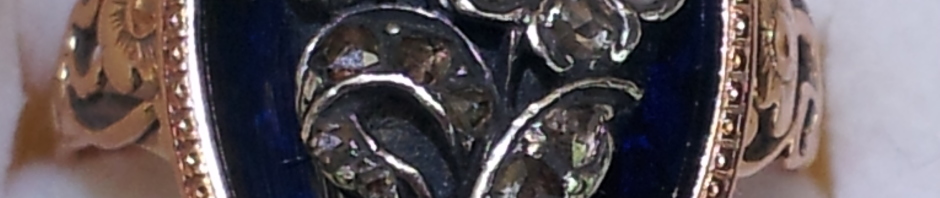
Floral motifs in the late 18th century mark a change in symbolic and mourning practice. Even more than just for the sake of mourning, the very ideal of wearing a flower marked a change in how people presented love and sentimentality. A bouquet of flowers is a fleeting message, but jewellery which could capture a… Continue reading Love, Flowers and Diamonds Create a Perfect Ring
The Urn, Willow and Onyx in the 18th Century
The urn and willow captured the imagination of the 18th century like no other mourning symbols. Their prominence of design and utility for the purpose of mourning overtook all of the symbols of the memento mori style and came to represent death without showing the actual mortality of the subject. Mourning is about love and… Continue reading The Urn, Willow and Onyx in the 18th Century
Hairwork Bow Inside a Neoclassical Pendant
This beautiful sentimental pendant houses the initials and hair of both lovers, tied in a bow with pearls. The concept of the bow, or knot, is a fundamentally strong one. That two separate strands can be tied together and never undone is so simple in its nature and resonates today as being a powerful motif.… Continue reading Hairwork Bow Inside a Neoclassical Pendant