A French Black Enamel Brooch, c.1860
Share this article with...


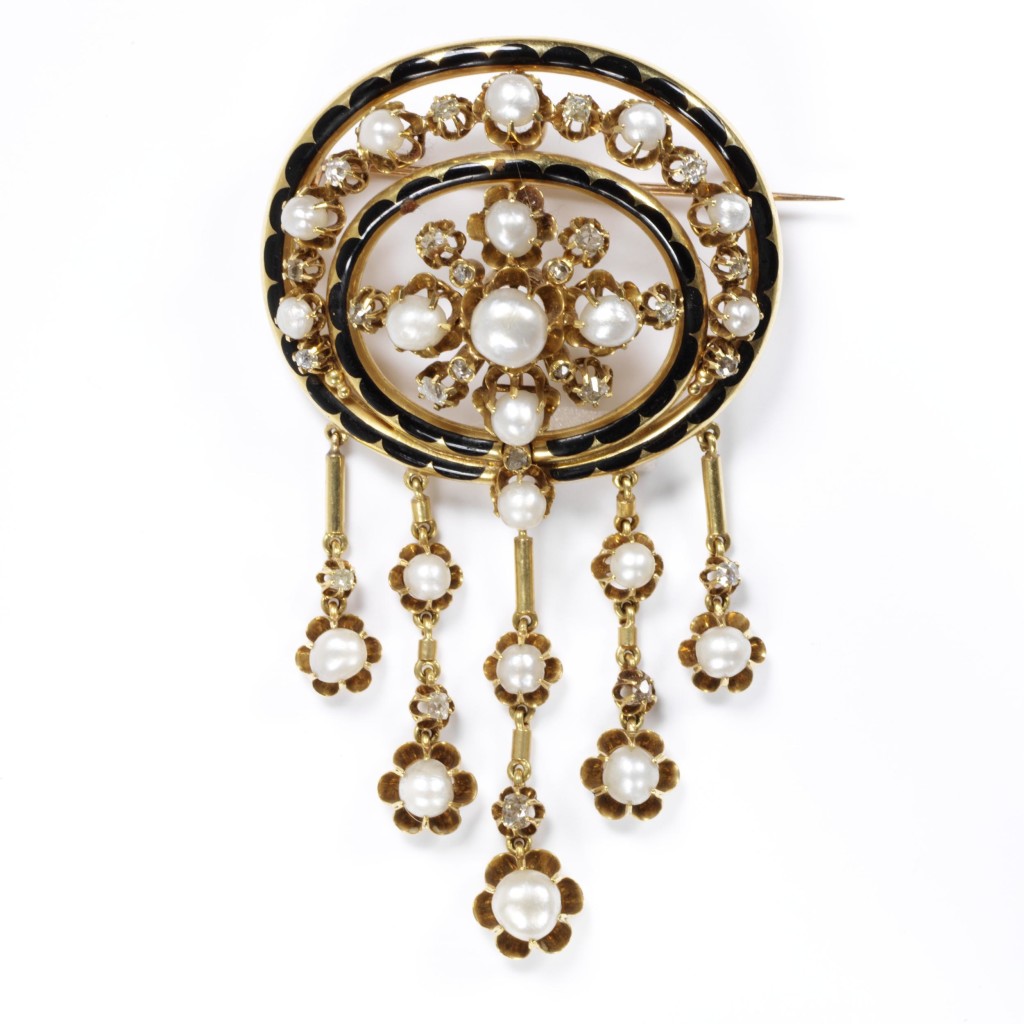
Openwork gold, enamelled in black set with diamonds and pearls, with pearls and diamond pendants
Global inspiration for jewellery design reflected colonisation and increased global transit that could share cultural art and values. The oriental route had opened up access to materials used in jewellery, dropping values and offering a fresh take on jewellery styles. Prince Albert, Queen Victoria’s consort, was influential in establishing the Great Exhibition of 1851, an event that could showcase the best and most interesting wonders that a culture could offer. Indian jewellery became a massive influence in European jewels following the Great Exhibition, with rich enamels on gold, coloured stones and pearls taking on a new vogue.
Propagating and influencing styles also put more value back upon the artist. Rather than larger and more ingrained jewellers following a standard popular style, singular jewellers could integrate other art styles in their jewellery designs, with funding from new wealth allowing for smaller and bespoke production.
In the 1860s, designs from the Middle East, particularly Syria and Palestine, became popular in London. The Art Journal advocated a new appreciation of these jewellery designs, of which, this brooch has an influence.
This brooch, inspired by the ‘moresque’ style, has arabesque patterns in the interlaced gold work crescent and brilliant-cut diamonds, surrounding a three-dimensional floral motif. This Moroccan influence was a design styling of the jeweller Crouzet, suggesting this may have been made by him.
Its style is an open pattern, with the gold, pearls and diamonds all forming an organic shape, right down to the drops of the pearls. Nothing is an arbitrary flourish; the design carefully planned and works in unison.
Crossover with mourning is seen in the use of black enamel, but without a certain dedication, there is no way to adequately justify this as being a jewel for mourning or daily wear. Mourning had become so ubiquitous, that the styles were set in mainstream fashion. Arguably, the 1860-70 period was the height of the mourning industry, with a slow decline through the 1880s changing fashion through a variety of reasons. For more on those reasons, please read:
> The Decline of the Mourning Industry
Mourning in high fashion was culturally acceptable, with mourning warehouses catering to all forms of the popular fashion. Whitby jet and its imitators were largely sentimental and fashionable tokens, rather than being simply about ‘death’, so when a piece of jewellery that is so perfectly constructed resonates wealth, its meaning and value to society is displayed. Black enamel was simply such a common theme in jewels that it becomes stylish.
Courtesy: V&A Museum
Share this article with...